At first glance, we thought we finally figured out what James Cameron was doing in the Deepsea Challenger. No, not trying to find the Heart Of the Ocean. It looks like he found the perfect place to screen the Avatar sequel - the inside of the Pacific Barreleyes head.
It’s one more oddity from the deep, and that clear head is definitely otherworldly. With the blue glow reflecting from the ROVs lights it really does look like this fish might be a rich source of unobtainium.
Of course, that’s not the case - but what’s really going on inside this Spookfish is almost as strange.
The Pacific Barreleye (AKA the Clear Headed Fish From Blue Planet II)
Blue Planet II is up on Netflix and it’s getting a second round of viewers. With all the wonders of the deep, there’s one that keeps coming up from this series. The Pacific Barreleye (Macropinna microstoma), sticks with you. It’s everything we love about the ocean - they’re beautiful, they’re weird, and they leave us asking a lot of questions.
The good news about this revitalization through Netflix is we have a lot more answers this time around.
For a long time, we didn’t really know much about this fish, and certainly not about the transparent shield around its head. Inside of this shield is a clear fluid.
You see, that shield looks really cool and interesting while submerged. But when you try bringing it onto dry land, it deflates and the fluid drains, and without previous knowledge, you’d have no idea how it looks down below. Instead, you get this:
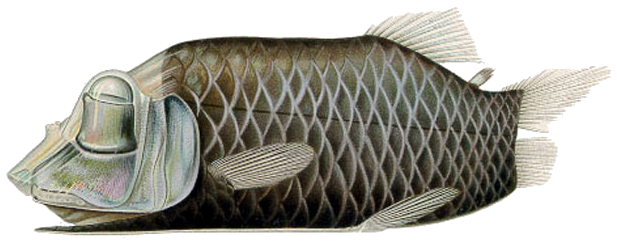
Like a lot of deep sea fish, many of our first glimpses and samples come from the nets of fishermen. So by the time we saw them, there was no way to tell they were these clear-headed beauties. Fortunately, our underwater observation tools have improved.
If you haven’t seen the episode we’ll give you a quick rundown on the fish.
What Is The Pacific Barreleye
The Pacific Barreleye is a stout deep sea fish. They’re one of many fish from barreleye (Opisthoproctidae) family, commonly known as Spookfish.
Though they’re one of many, they definitely stand out from the other due to their strange, see-thru head.
Why Does That Fish Have A Transparent Head?
Fair question. In short, so that it can see. It’s going to take a little more explanation to get to a more complete answer, But this is really the best place to start. The eyes of the spookfish are inside of the snowglobe that is its head.
When you look at the face of the Macropinna Microstoma you see two circles above the mouth that are definitely its eyes. Those aren’t its eyes. They’re more or less its nostrils.
The actual eyes are just below those two green “leaves” inside its head. The eyes are long and tubular, like all barreleyes, which is how they got their name. Sometimes, scientists like to be blunt. Kind of like how “octopus” is essentially Greek for, “eight feet.”

Since the eyes are inside of the shield, the shield needs to be transparent for the Pacific Barreleye to see. Of course, that brings about the question of, “What are their eyes doing inside their heads in the first place?”
Don’t worry, it’s all going to make sense. And I’ll admit, there’s a little bit of guesswork (we’ll let you know where), but it seems to come down to their hunting.
How Pacific Barreleye Fish Hunt
These guys are deep sea fish - not snailfish at the bottom of Mariana Trench deep, but deep. They’re just below where the sunlight can’t penetrate. It sounds a little sad, but it’s actually a sound strategy.
Their unique eye shape makes spookfish especially good at collecting light, improving their vision in low light settings. But, adaptations for seeing in the deep sea come with their ups and down. The tradeoff is that they have a narrow field of vision, kind of like looking through binoculars.
Still, it’s a good trade, since it basically means they can see their prey, but their prey can’t see them.
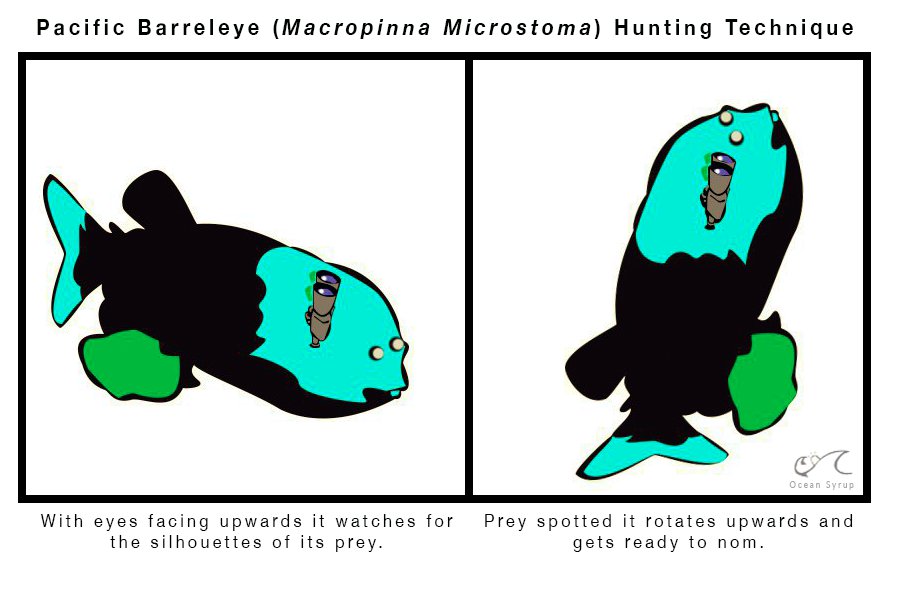
The Pacific barreleye is almost always looking upwards. In fact, for a long time, we believed their eyes were fixed. Since then, however, we’ve observed them rotating their eyes.
The reason they’re looking up is that they can see the silhouettes of their prey (who are closer to sunlight) passing above them. This gives the Macropinna Microstoma a chance to spot and sneak up on their prey.
It’s a good thing they have good enough eyesight to inspect their prey because they’re picky eaters. These spookfish have tiny mouths, which limits them mostly to small jellyfish, crustaceans, and other tiny drifting creatures.
When they go to attack, they point their eyes forward. They’re trying to get small serving sizes into a small hole, so there’s not a lot of room for error. So they need to watch their prey.
The bioluminescent jellies are especially easy to spot and appear to make up an important part of their diet. Having their eyes inside of their head protects them from the stinging tentacles.
Even more so, and this is where a bit of guesswork is coming into play, it’s believed that they get a lot of their food by stealing it from siphonophores.
On paper, a siphonophore should be too much for the little Pacific barreleye to take on. We’re looking at a fish that averages 6 inches in length against an organism that can be longer than a blue whale.
While the siphonophore won’t really notice the macropinna, its long tentacles sting on contact. And they pack a much bigger punch than the little jellies the spookfish eat whole. And when the spookfish swims in to steal food trapped in the tentacles, it can’t really avoid a sting. While its body seems to be able to handle this, sensitive organs like eyes could not. But, their eyes are safe inside the clear, fluid-filled shield.
And that is basically the running theory on why Pacific barreleyes keep their eyes inside of their head.


