The deep sea shares some similarities with space. It’s cold, it’s dark, and in the deeps, no one can hear you scream.
There’s also extreme pressure and minimal access to food. Altogether, these challenges have churned out some insanely interesting (aka creepy) critters. It makes exploring the deep sea infinitely cooler than the depths of space — come at me NASA.
But one of the biggest challenges for deep sea exploration is one that we share with the animals that live there. There’s no sunlight. So how do deep sea creatures see in the deep?
There are a lot of different approaches to seeing in the deep sea, and for the most part, how they’re applied really depends on how deep you go.
How Deep Is The Deep Sea
Technically, the deep sea is anywhere from 200m to 3.5km. To put that in perspective that’s the difference between stacking NBA champion, Pascal Siakam, 100 times and stacking him 1750 times.
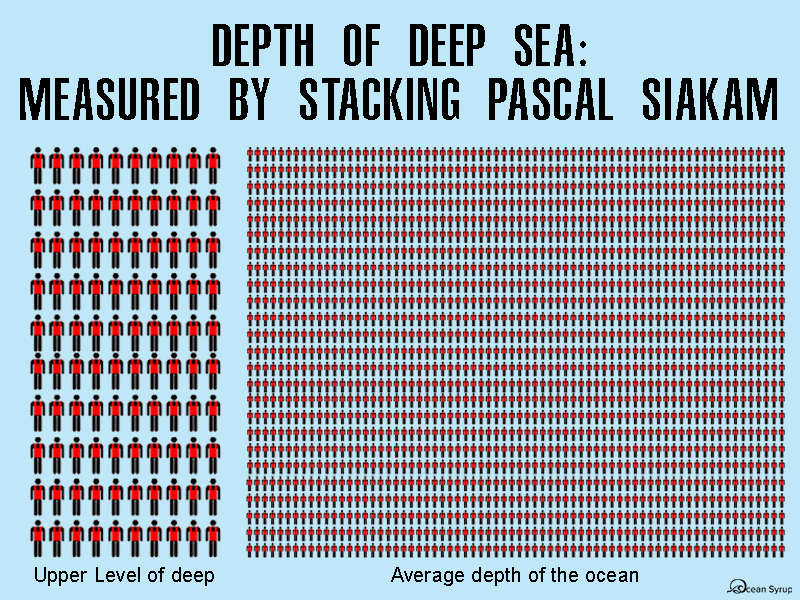
It’s a lot of space. As a result, the deep sea has almost as much range and versatility as Spicy P has on the court.
To understand how deep sea eyesight works, we’ll look at three basic zones of the ocean.
- The Sunlight Zone (Epipelagic Zone): <200 meters. This is the area above the deep sea. Sunlight penetrates here, it requires less specialization for seeing. It’s still gets pretty deep — the most human divers only go about 40 meters deep.
- The Twilight Zone (Mesopelagic Zone): Between 200 and 1000 meters. It gets pretty real down here. The sun does penetrate this deep, but the rays are pretty faint. So this is where lots of deep sea animals get weird with their vision.
- The Midnight Zone (Bathypelagic Zone): Between 1000 and 3500 meters. It’s called the midnight zone because it’s essentially pitch black. If you see light down here, it’s probably coming from something bioluminescent, not from the sun. The pressure here is a little under 6000 pounds per square inch, so it takes some serious specialization to live down here.

Below these layers are the Abyss and the Trenches. When you get this deep, there is no natural light. Just a bunch of pressure. And yet, there are still animals here.
So with all this in mind, we’re going to separate the ways how deep sea creatures see into two sections:
- In Low Light (Twilight Zone and upper Midnight Zone)
- In virtually no light to zero light (Midnight zone and below)
How Deep Sea Creatures See In Low Light
Sight is essential for most animals. And not just so you can witness how unwatchable Friends is. But for seeking food, finding mates, and spotting predators. So when the light gets low, nature gets creative. Here are a few ways ocean animals see in minimal light:
Looking Up
Some deep sea predators swim just deep enough to make it hard for their prey to see them. While their bodies are hidden by the dark waters, the shapes of their prey are visible above them.
This is why the Pacific barreleye has a transparent head. They can rotate their eyes inside of their head so that they can look directly upwards to spot prey swimming above. Then they can rotate the eyes forward as they line up to attack.
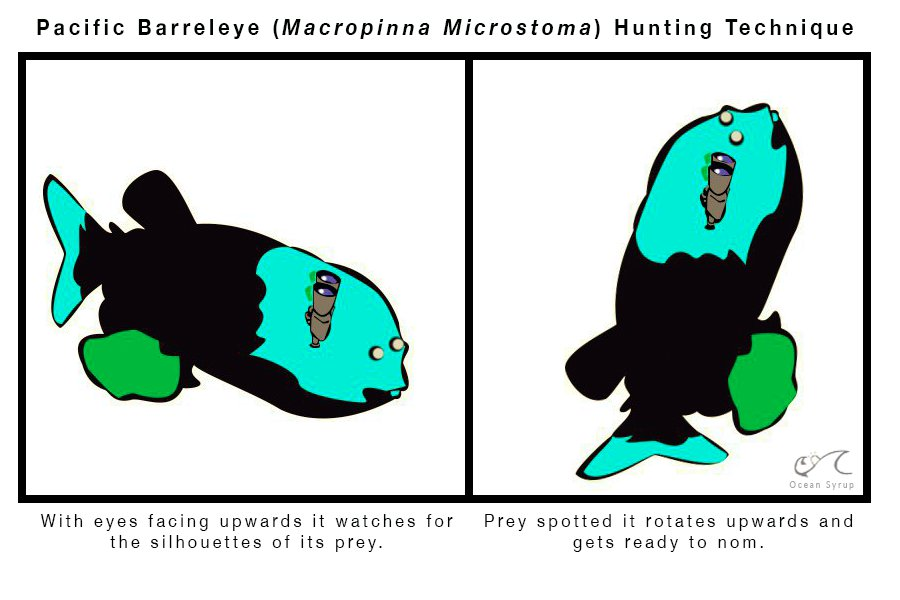
It pretty much makes the Pacific barreleye the Batman of the sea. They hide in the darkness and appear, as if out of nowhere to attack their prey. Then they disappear into the cover of darkness. All they’re missing is a little vigilante justice to become the Dark Knight. Also a butler.
The newly discovered “Pocket Shark” uses a similar tactic. They swim deep enough to keep out of sight of their prey. But instead of coming up to attack, they lure their prey down.
The pocket shark shoots bioluminescent goo in front of itself, and when prey comes down to investigate, they gobble ‘em up.
Mirrors in the Eyes
Mirrors in the eyes aren’t unheard of above the ocean. Some nocturnal animals, like owls, have a mirror-like layer behind the retina instead of lenses. This allows them to get more out of less light. But there isn’t anything out there, quite like how scallops do this.

Scallops have one of the most complex image processing systems out there. They use a network of 200 eyes with concave mirrors made out of guanine crystals.
Guanine is a naturally occurring super-reflective material. A variety of animals use it to reflect or manipulate light. It’s found in shiny fish scales and chameleon skin.
This reflective surface is almost perfectly smooth, allowing it to work like a telescope mirror. The guanine crystals prevent optical distortions while maximizing the use of light. This allows scallops to see even in low light conditions.
After being focused through the crystals, the images from all 200 eyes are combined into one image. We’re hoping that after all that, it’s at least in HD.
Big Eyes
For the most part, when you start to go deep, the animals get smaller. There’s less food, and the extreme cold and pressure take up more resources to hunt and process meals. While there are plenty of instances of deep sea gigantism, the vast majority of creatures here are getting smaller. And yet, their eyes get big.
Fish eyes, like our own, rely on light to register images. So for a lot of animals, when there’s not a lot of light, they opt to have a whole lot of eye. This isn’t really a big shocker. Even on land, many nocturnal animals have big eyes.

The stout blacksmelt has a small body and huge eyes, earning the nickname the Owlfish. This little guy has been found as deep as 6600 m. So he’s used to conditions with minimal light. To cope, they have huge eyes with lots of cones, allowing them to make the most out of the light available.
And just for fun, here’s a video of a stout blacksmelt losing to a squid:
How Deep Sea Creature Without Sunlight
Most fish living in the deep sea have eyes that are extremely sensitive wavelengths around 460-490nm. This makes it easier for them to pick up blue bioluminescent light and residual sunlight.
They Make Their Own Light (Bioluminescent)
Once you hit the midnight zone, a lot of the visible light you’ll find is the result of bioluminescence. This light is the result of a chemical reaction that allows living organisms to emit light. About 90% of creatures in the deep sea are capable of bioluminescence

A basic breakdown of how bioluminescence works is like this:
- The fish (or other organism) has a compound called luciferin (golly, how devilish!).
- When combined with the enzyme luciferase it oxidizes the luciferin.
- This process
summons the devilcreates a chemical reaction that emits blue light.
This chemical creation makes bioluminescence different from other sources of light, which are generally a result of heat. It also differs from fluorescent organisms which glow in reaction to light, and do not glow in complete darkness.
Fish, and other organisms, use this tool for a boatload (submarine load?) of different functions:
Hunting
Some species generate this light to use as headlights. This makes it easier to hunt prey and find mates. Others, like the humpback anglerfish, use the light as a lure to attract prey.
Communication
Another common use of bioluminescence is communication. For the most part, the purpose of this communication is to find or attract a mate. Simply put, it’s hard to find love in the deep ocean. So flashing bioluminescent light is deep sea Tinder. Except everyone is swiping right, and almost no one gets ghosted.

Defence
It can also serve as a defence tool. Some animals, in areas with dim light, make themselves luminescent to camouflage themselves in the light. This attempt to match their lighting to the natural lighting is called countershading.
Some squid have an octopus-inspired defence. Instead of releasing ink, they drop a bioluminescent cloud and make their escape. Other creatures, like scale worms, drop glowing scales decoy. Some brittlestars do this by dropping a glowing body part. The body part continues to flash, drawing the predators attention away.
You Don’t Have To Turn On The Red Light
Rooooooooooooooxane! Most deep sea fish are most sensitive to blue light. It makes a lot of sense. Bioluminescent light is mostly blue, so they need to see it for hunting, mating, and defence. As well, blue ambient light penetrates deeper into the ocean — that’s why underwater photographers use red filters when they start going deeper.
Red ambient light doesn’t penetrate as deep into the water, so if you take a picture below 5m it’s likely to have a green or blue hue. Adding a red filter, ads a tint that corrects the image.
This is where the dragonfish comes in.
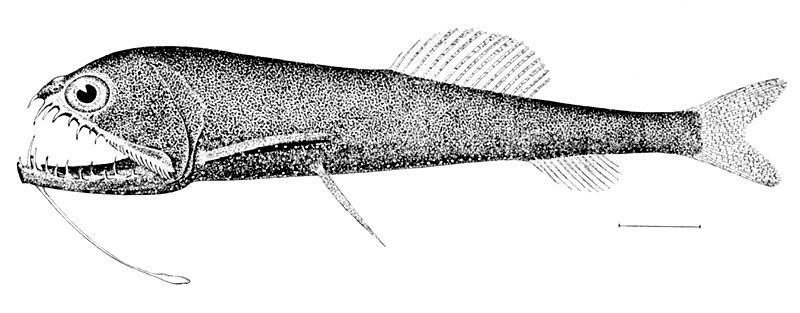
Many species of dragonfish do produce bioluminescent blue light like other deep sea fish. But where they stand out, is that they can also emit a far-red light, using photophores in their eyes. Since there’s little to no red light available in the deep ocean, most creatures there aren’t receptive to it.
This lets dragonfish light up their prey without their prey seeing the light. Their stealth game is on point. Imagine searching for someone using a flashlight that only you can see. They’re rocking night vision goggles while everyone else is stuck in the dark.
How the Dragonfish Turned Its Eyes Into Night Vision Goggles
In human eyes, we have a protein called rhodopsin. Rhodopsin is receptive to green light, which improves our vision in low light. But in dragonfish, their rhodopsin was sensitive to both green and red lights.
The reason is that they have a chlorophyll derivative, that is sensitive to red lights, in the rhodopsins. This allows them to pick up traces of red light that other deep sea fish can’t see. But it might not just be fish that can use this biotechnology.
A pair of biohackers used this info to create night vision eyedrops. They took chlorin e6, a chlorophyll analog, and put it in their own eyes.
Putting untested chemicals into your eyes is a bad idea. And this isn’t an exception. Except for one thing, it worked. At least, maybe. In the testing they did the one person with it outperformed the four people without it.
But before you go out dropping random ingredients into your eyes to see what you can see, do keep in mind, they got lucky. Scientists do still believe that putting this substance in your eyes could cause blindness or permanent damage. It’s a high risk, for a temporary effect.
On top of that, it made the eyes look insanely creepy. They were all black as if the pupil had dilated across the entire eye. Basically, they turned into an emoji.
There’s still room for debate on whether or not chlorin e6 eye drops actually do improve night vision. After all, the testing was insufficient with no baseline, placebo, and a small test size. But that doesn’t mean it doesn’t work. It just means we need more testing.
Of course, we’re not volunteering. We don’t want to end up like tripodfish.
They Just Skip Seeing Altogether
As Homer said, “trying is the first step towards failure.” And as it turns out, plenty of deep sea creatures took that advice to heart. In the deep sea, seeing is hard — but giving up is easy. So, many species either partially or completely give up on vision.

Fortunately, there is some payoff here. While some of these creatures are completely blind, they have other senses heightened, and they make use of super-sensitive feelers.
Basically, receiving and processing sight takes up a lot of the brain’s resources. Animals that don’t have to see can use those resources elsewhere, like developing a more complex sense of touch. In zero light, it’s a good tradeoff, since you wouldn’t be able to see anyway.
It’s like Daredevil. Sure, he’s blind, but to make up for it, Stan Lee gave him a law degree. So now he can make as many puns about the blind justice as he wants. They won’t be good, but people will patronize him anyway.
The tripodfish is a cool example of a creature that took the trade. They sit at the bottom of the ocean floor, where no sunlight penetrates. So instead of using sight, they use heightened senses to catch prey.
Just like a spider feels a fly land on its web, the tripodfish can sense vibrations on the ocean floor. This allows them to identify and target prey.
Echolocation
Not every animal we find in the deep sea stays there. The cuvier’s beaked whale, for example, frequently dives to depths exceeding 2,000 meters. How deep they can go is uncertain, but they’ve been recorded diving nearly 3,000 meters.
Like all whales, the beaked whale needs to surface to breathe. That gives some pretty dynamic changes in their habitats, so they need less environment-specific adaptations for seeking prey. While they do have decent eyesight, it’s not enough to help them in the deep. So they use echolocation.
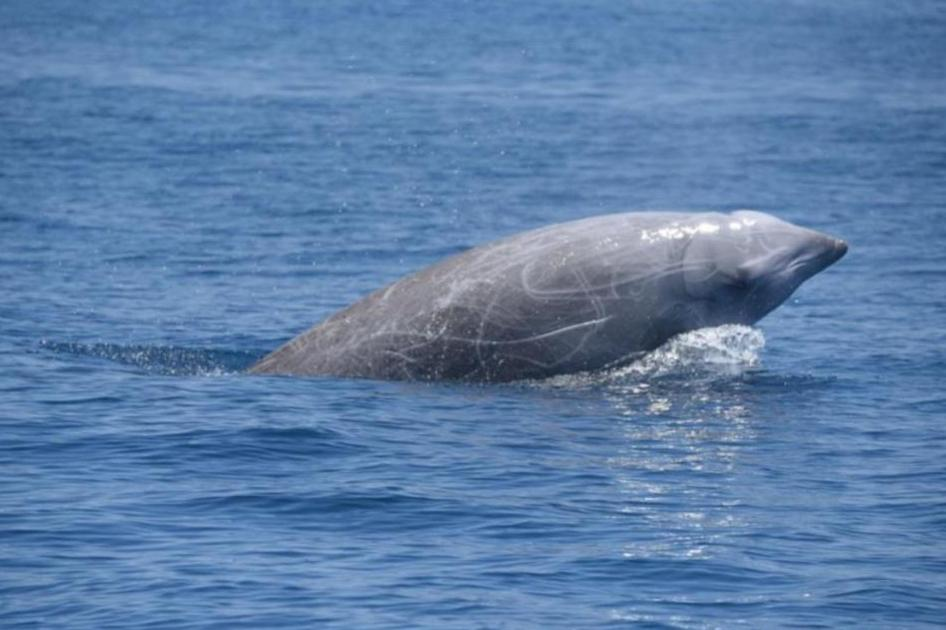
They use a clicking-style of echolocation that lets that bounces back signals so they can “see” other animals in dark waters.
We won’t go into too much detail here, because you know what echolocation is. It’s the same thing that bats, submarines (and Batman in some comics) do.
Ampullae of Lorenzini (Electroreception)
We saved the best for last. And by best, we mean sharks. Sharks have specialized organs for detecting electric currents called the ampullae of Lorenzini. It’s hypothesized that this electroreception helps them navigate using Earth’s magnetic field. And we know it helps them hunt down prey.
Every living thing gives off an electronic signal. Along the shark’s head are pores which receive this signal. This makes it possible to find prey in combination with, or in place of, their senses of sight and smell.
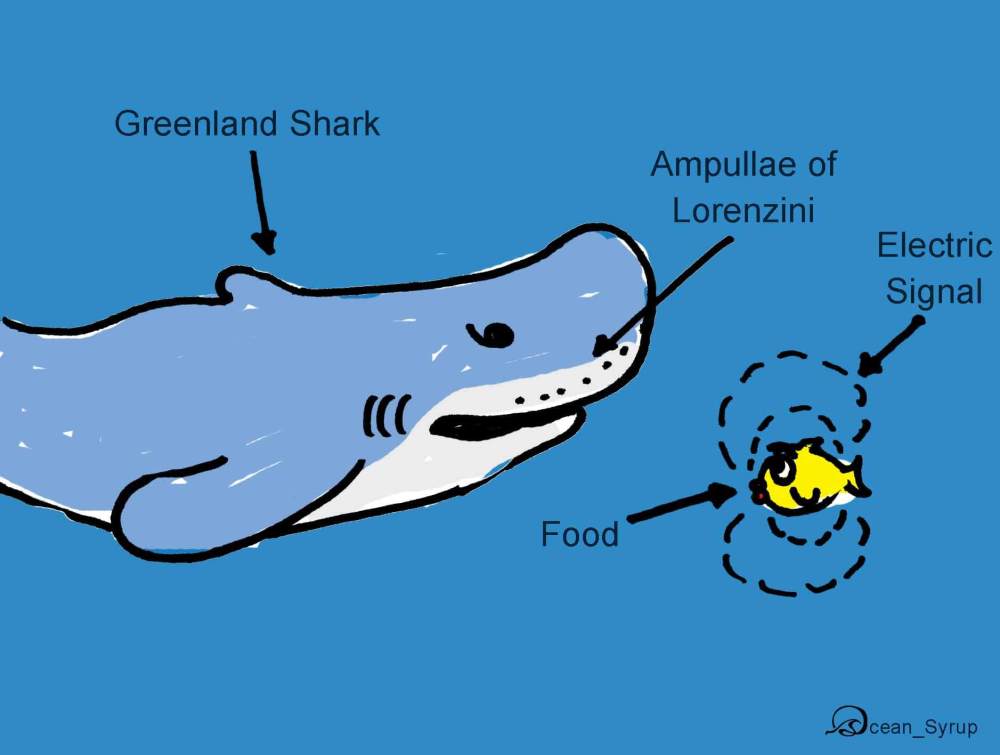
The electrical signals sent out let sharks know:
- The location of prey
- Their size
- If they are injured (ex. irregular signals from the irregular movements of an injured fish)
The ampullae of Lorenzini are separated into three categories based on size; macroampullae; miniampullae; and microampullae. The larger the organs, the more receptive they are. This makes macroampullae, which are found in elasmobranchii (like the Greenland shark), the most effective of the three.

The Greenland Shark & Ampullae of Lorenzini
With the Greenland shark often swimming at a depth of 2200m (the midnight zone), this tool is particularly useful. Their electroreceptors can help them detect food, regardless of whether they can see.
But food isn’t the only way the ampullae of Lorenzini help Greenland sharks survive. Recent studies are showing how SMART (Selective Magnetic and Repellent-Treated) hooks could help prevent them from getting caught on longlines.
Currently, the Greenland shark is the most common bycatch in Canada’s Greenland halibut bottom longline industry. About 50% of those end up dying. To avoid this, SMART was employed to try and deter the sharks from approaching the hooks.
This particular approach hasn’t worked. But there’s hope that they may yet be able to use this signalling to prevent bycatch. Of course, avoiding harmful fishing practices, like longlining, would be the best option. But at least efforts are being made.
Not Just Sharks
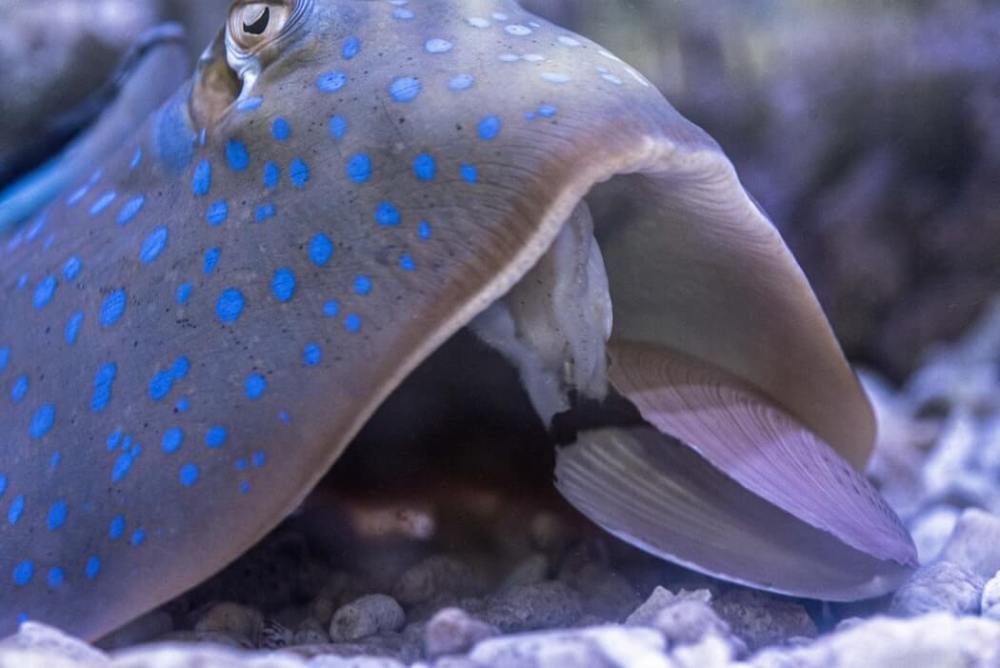
These specialized electroreceptors are often touted as unique to sharks. But they’re also found on the flat sharks: skates and rays. Instead of having the pores along their head, they’re all along their body. Just like sharks, these pores are visible to the naked eye, looking like spots.

We’re Only Scratching The Surface
Even with all the advancements in technology, we’re still in the infancy of deep sea exploration. The creatures we’ve already identified, we’re only beginning to understand. And we have no idea what other alien-like adaptations remain to be discovered.
There’s a bright future in exploring the depths of the ocean. And just like the deep sea creatures, we’re still finding new ways to see it.


Thank you so much for this. it helped me alot. this website is filled with info and it has a healthy dose of humor. The website is clean too. Thanks