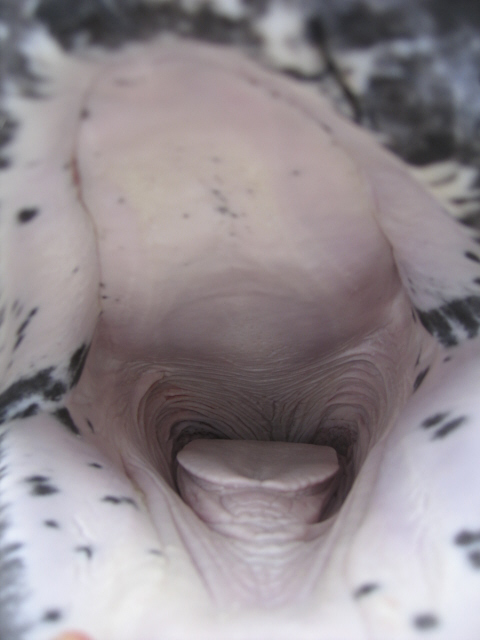
Staring down the maw of a narwhal is a bit off-putting. Their closest relative, the beluga, hs 34 teeth. But a narwhal’s mouth is empty. Just flesh, tongue and a big creepy hole. Because narwhals don’t have teeth (at least visibly). Although, they do have tooth.
So what’s going on here? Even their next closest relatives, dolphins and porpoises, have their mouths lined with pearly whites. But there’s no physical evidence to suggest that narwhals ever had teeth in their mouths.
But, like we said, they do have a tooth. Side by side belugas and narwhals actually look pretty similar. They act kind of similar. In fact, there’s at least one record of belugas adopting a narwhal in the wild. But there is one clear difference - the horn.
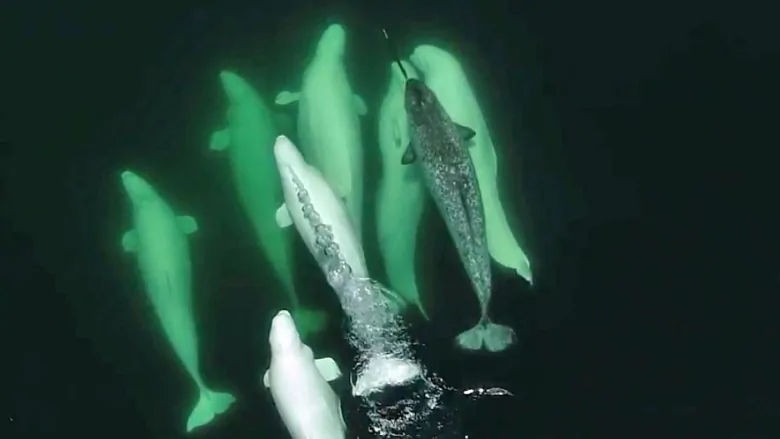
One of these things is not like the others | GREMM
That horn is why the narwhal is popularly known as nature’s splashy unicorn. Sure they don’t fly, they probably aren’t magic, and they don’t have a flowing mane. But we like ‘em anyway.
Narwhal Horns are Teeth
You probably realized we were ramping up to this. Obviously, they aren’t quite the same as human teeth. They’re more similar to elephant tusks, which is why their “horns” are more properly referred to as tusks. Unlike an elephant, however, their horns aren’t in symmetrical pairs.
Although, the asymmetry isn’t the only thing that makes them different from other tusked animals. Narwhal horns grow in clockwise helix spirals. They’re almost perfectly straight, and they can grow to more than half the size of their body.
On top of all that, their tooth structure is all wonky. A normal tooth, or even tusk, is tough on the outside, and soft on the inside. There’s a tough outer casing protecting the interior, like the chocolate-dipped shell on a soft serve ice cream.

But with Narwhals the tooth exterior is soft, getting harder as you approach the center. Although, like us, their pulp and nerves are still in the middle part. The soft outer area actually helps protect this central rod.
The Unicorn of the Narwhals
Alright, we admit. We lead you astray a little bit when we said narwhals only have one tooth. Technically, they have two. Although the second one isn’t visible. Only the first tusk grows out through their skin.
The other, smaller, tooth is vestigial. Which means it’s a remnant of its past evolution. Which means it’s pretty much useless (at least as far as we know).
Of course, that’s not always the case.
Take a look at people, people don’t have tails. Except for sometimes, when they do. It’s pretty rare, but every now and then people are born with tails. You have to jump back about 20 million years in evolution to get to a point where our ancestors had tails, but they still happen.
That vestigial tail has stuck for all millions of years, all so we could come up with Goku.
Just like a vestigial tail, the narwhal’s vestigial tooth doesn’t always stay in the dark. About 0.2% of males grow a second tusk, making two-tusked narwhals the rarest of them all.
The most majestic and magical whale is the Twonicorn.
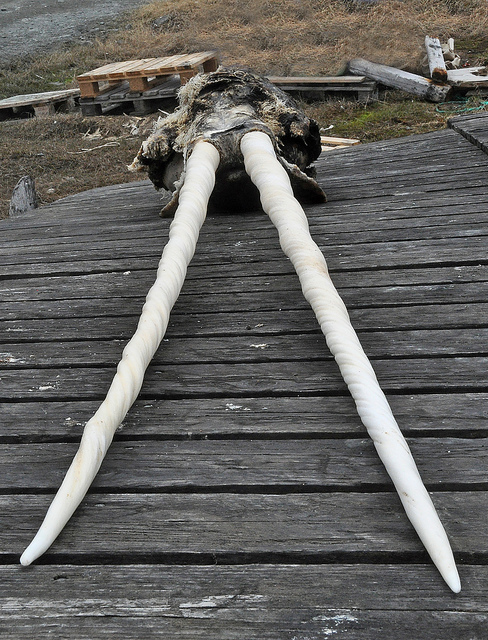
What Do They Use The Tusk For?
Or rather, what’s the porpoise of narwhal tusk? Well, scientists have a lot of guesses, but for the most part, they’re unsure. Drone footage has shown them using the horn to stun fish while hunting. But that’s probably not it’s only purpose.
One of the older theories is that it’s used in sexual selection. This pretty much stems from the tusk being more of a male thing. Only about 1 in 6 female narwhals have tusks, and theirs are usually smaller than male tusks.
Sexual Selection
A once common belief was that the males would have spirited jousting matches, sword fighting with their tooth. All in a contest to win a nar-lady’s affection - or maybe avenge their father, whatever. It creates epic imagery, which made it a popular idea.
via GIPHY
People have even seen them knocking their tusks together, helping to validate this theory.
Unfortunately, closer observation has ruined this awesome scene. In reality, when the males go tusk to tusk, it’s not much of a duel. It’s more rubbing them together, and it’s probably just for communication.
While the battle-tusk theory is out, sexual selection may still be a factor.
“Size matters, not how you use it.”
-Narwhalthuring Heights
In structure, a narwhal’s tusk is nothing like a deer’s antlers. Antlers are closer to our hair and nails than teeth. But they can be a similar sexual indicator. Both these tusks and antlers take a lot of energy to grow. So if a doe sees a buck with a big rack on his head, she knows he’s a stud.
Big antlers show that he’s got a lot going on since he can afford to expend energy growing them. It’s like flashing a Rolex (except that antlers are awesome).
In this same way, narwhal tusks seem a likely indicator of a male in good health. And it seems like it could be at least part of how a female chooses her mate.
A Sensory Organ
“Teehee, shouldn’t this go under sexual selection?” C’mon, get your mind out of the gutter there bud. Despite the tickling the ivories euphemisms, a narwhal tusk is no good for that.
However, there has been some suggestion that narwhal horns help them navigate. There are varying ideas ranging from using them to test water contents and temperatures, to electrosensory organs like the noses of sawfish.
There’s no real concrete evidence of either. Although the water testing idea has potential. They could use inlets in the dentin to test the salinity of the water (how salty it is), and use this information to swim to areas with more fish.
Breaking The Ice
I know, all of these kind of sound like sexual selection. But literally breaking the ice would be a big benefit for narwhals. They swim in, literally, freezing cold waters. It’s easy for them to get trapped under the ice, especially in spring as ice melts and reforms.
Once stuck, they’ll often drown or fall prey to polar bears, humans, or walruses. Yup, even walruses, there is no tusk alliance in nature.
Having a big, pointy ice-breaker on your head would definitely be a real boon for navigating Arctic waters. But, there’s no evidence of this. Which is great news for the walrus.
Spear Fishing
This one is probably the coolest sounding one. Picture it, a narwhal jousting its prey. It’s the knight and horse built into one, like some kind of awesome battlebot. It charges down the fish, spearing it on its face-lance.
As awesome as a narwhal-kebob would be, this is another one that’s probably not true. For one, no one’s ever seen it happen. For another, how would that even help? The tusk doesn’t go through the mouth, so they’d just have food on their tusk with no way to get it.
That being said, we do know they can use the horn to hunt. Using drones, Canada’s Department of Fisheries and Oceans caught the first footage of narwhals stunning cod with their horns and eating them.
So what’s the porpoise of narwhal tusks? Probably a bunch of things, here’s a quick recap:
- Hunting
- Communication
- Sexual Selection
- (Possible) Navigation
- Unicorn Magic
There could still be more uses as well. Hopefully, advances in drones and observational technology will help uncover more about their behaviour.
Bonus: Why Aren’t Narwhals Called Narwhales?

Wouldn’t that be easier for everyone? Yes, yes it would. People spell it with an ‘e’ at the end all the time, and who can blame them? They are whales after all.
Well, it comes down to some pretty dull etymology. But don’t worry, their scientific name totally makes up for it. A narwhal’s scientific name is Monodon monoceros - which means “One-Tooth Unicorn.”
Awesome.


