Pilot whales are the bad news whales. If something uplifting happens in the cetacean world, it’s usually humpbacks or dolphins. If it’s a more general interest piece, you’re looking at orcas or sperm whales. But when things go wrong, they always seem to be going wrong for pilot whales.
We’re taking a look at some of what’s happening, and why it always seems to happen to pilot whales. Are they bad at being whales or do they just have terrible luck? We’ll kick it off with a simple enough question.
Are They Really Even Whales?
Despite their name, pilot whales are best categorized as dolphins - which do fall under the cetacean (whale) infraorder. Basically, dolphins are whales the same way foxes are dogs. Technically yes, but they’re pretty clearly their own separate thing.
That being said, they aren’t your average dolphin. For one, they’re pretty big. Not as big as orcas, the largest dolphins, but often more than twice the length of a common bottlenose (Flipper).
In appearance, it really depends on the angle you catch them at. A side view of their body is pretty whaley, but they have those expressive dolphin faces.
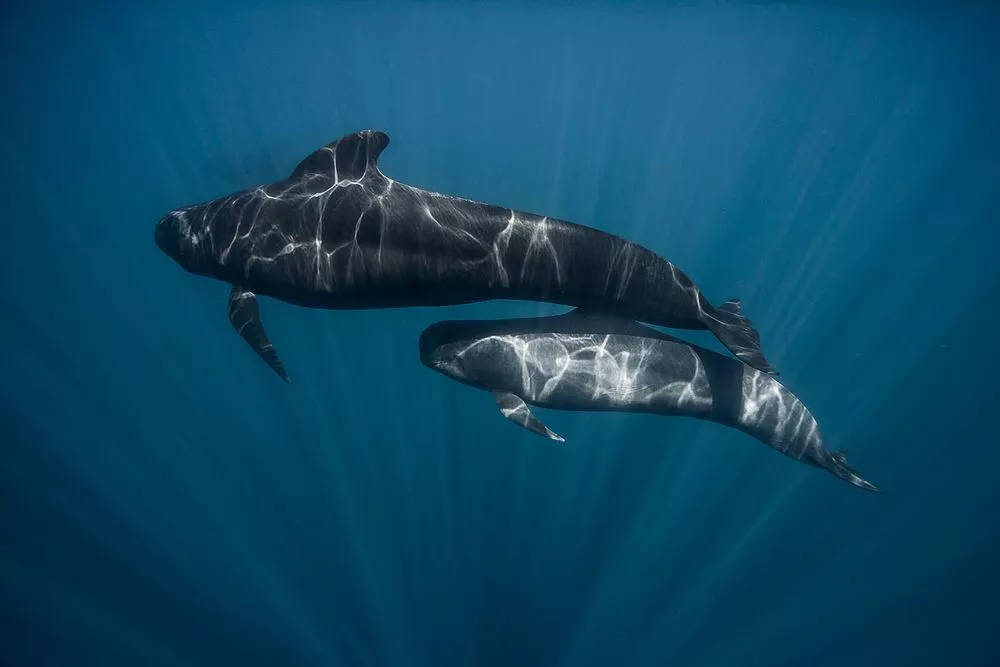
But enough about that, let’s take a look at some of the bad things that seem to keep happening to pilot whales.
Choking On Fish
Pilot whales (Globicephala) can eat as much as 30 lb per day. So if there’s one thing you’d expect them to be good at, it’s eating fish. But, it’s not unheard of for them to wash up on shore having choked to death on fish.
As someone who’s not a fan of seafood, that’s about the worst way to go I can imagine. But still, it seems odd that they’d be making a mistake eating fish. So what’s going on?
One of the ways it happens brings us to why whether Globicephala are dolphins or whales matters.
In What Comes Out Of A Whale’s Blowhole we talked about the laryngeal plug. This plug is what stops water from entering their lungs. Unlike whales, dolphins have exhibited control over this plug. Most won’t remove it because of the risk of drowning it presents. But at least in pilot whales, it may be that it is more easily dislodged as well.
Dead pilot whales have been found with fish lodged under the laryngeal plug, causing them to drown. Whether that’s a result of the fish knocking it loose or them physically removing it is uncertain.
But even if the laryngeal plug issue comes down to pilot error, some choking are just plain bad luck. Sometimes, a fish will swim straight down a pilot whale’s blowhole. Why? It’s hard to say, maybe it looks like an inviting hidey-hole, maybe it’s avenging 30 lbs worth of its friends.
But, regardless of the reason, if the fish is large enough to block airflow the whale can choke. Or if the fish blocks the nasal plug from closing, water can get in and cause drowning.
Pilot Whales Get The Bends
The bends, aka decompression sickness (DCS), is best known as affecting human divers who ascend too quickly. The US Navy estimates chances of DCS increase if ascending at rates faster than 20m/min. But whales go faster, from deeper, so why don’t they get the bends? Well, they do.
As different as they look on the outside, whales have pretty similar internal systems to humans. Of course, they’re better adapted to deep sea diving then us. For example, they’re able to prevent nitrogen buildups just by holding their breath. As well, some of the deeper diving whales like sperm whales have collapsible lungs. But even with these adaptations, they’re not immune to the bends.
Even Cuvier’s beaked whales, the deepest diving cetacean (reaching nearly 3000m) can suffer from DCS. Studies have found that Cuvier’s beaked whales were getting the bends during naval sonar testing.
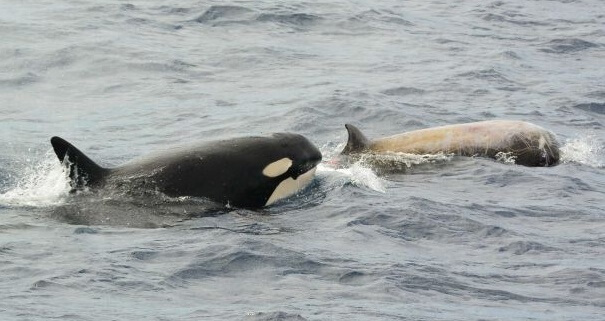
The working theory is that the whales were confusing the sounds with orca sonar. Orcas are their predators. So as the beaked whales would begin to resurface, they’d hear the sonar and dive back down.
Each time they came back up, they’d hear it again and continue on this unnatural dive pattern. As a result, they would eventually get the bends.
Pilot whales have also been found exhibiting signs of the bends. The assumption is the cause is likely the same, either from naval sonar or while trying to avoid predators.
Mass Suicides - Why Do Whales Beach Themselves En Masse?
It seems like every 1 to 2 years you hear about mass beachings of dozens, or even hundreds, of whales. People will cite all sorts of reasons as to why, from aliens to suicide. But one thing is consistent. It’s pretty much always pilot whales. So what’s going on?
Are they suicidal, or are they just incompetent?
Well, it seems like there are a few reasons. The bad news is some of those reasons are, at least partially, our fault.
One of the causes is getting the bends. It’s a painful disease, and even in humans, it can cause death. If we detect decompression sickness, we treat it with decompression chambers. This can lead to a complete recovery. But whales don’t have a way to treat it. For pilot whales, decompression sickness usually means a slow, painful death. So instead they just beach themselves.
And once again, that’s often caused by our own sonar equipment.
That’s a bummer. So let’s take a look at another reason, that might not be completely our fault. For this, we look to New Zealand.
During New Zealand’s spring and summer months, these mass beachings are not uncommon. Pilot whales often come and hunt in large groups. The coastline has a number of bays and inlets. When hunting in a group this can make for attractive hunting grounds because fish are easily trapped, making for easy meals.
The downside, is that pilot whales rely mostly on echolocation to hunt. These shallow bays, rock formations, and muddy bottoms can confuse their sonar causing navigational errors as a result, hundreds can get stranded on shore.
Eating Plastic Bags
This past summer a pilot whale made headlines for dying after eating 17 lbs of plastic bags. And unfortunately, this isn’t uncommon either. Because whales can’t read the choking hazard warning labels. Or, even more so, because 10% of our garbage ends up in the ocean.
We’ve heard a lot this past year about some of the plastics that often end up in the ocean. Straws, disposable cutlery, and plastic bags are some of the biggest culprits.
These plastics are pretty lightweight so they’re easily blown into the ocean. And they can take over 1,000 years to decompose, so they have lots of opportunity to do so.
Part of the reason those specific items are a concern is that they are easily mistaken for food. For example, jellyfish are a popular snack for some pilot whales. But the difference between a jelly and a plastic bag floating in the water is negligible to these whales.
They’re a similar shape, and a plastic bag can even have similar movement to a jellyfish underwater. Since pilot whales rely more on echolocation than sight to hunt, the mistake is easy to make. And, as you can guess, eating plastic is just as bad for whales as it is for us.
While pilot whales are prone to making this mistake, they aren’t the only ones. Just this past fall, a sperm whale was found dead with over 1,000 pieces of plastic in its tummy. That included plastic bags, cups, and even sandals.
The ocean is full of opportunistic feeders. When garbage ends up in the ocean, it gets eaten and animals die.
So Why Do Bad Things Keep Happening to Pilot Whales?
Well, it’s a bit of a mix. Sometimes it’s their fault, sometimes it’s our fault, and other times it’s the sheer misfortune of sharing the ocean with some kamikaze fish. Pilot whales may be unlucky, but they’re playful, intelligent creatures (even if they do eat plastic) and we’d sure like to keep them around.
One of the easiest things you can do is to try and reduce your use of disposable plastics. Reusable materials can replace disposable plastic items. For instance, avoiding disposable cutlery, lunch bags and shopping bags can drastically reduce your plastic footprint.
As well, there are all sorts of alternative materials like paper and bamboo that can replace plastic. Encourage your local businesses to switch from plastic to paper for takeout.