What’s the Right Plural for Octopus?
The plural form of octopus is the animal version of there, their, they’re. People are up in arms about it. Whether you write octopi on Reddit, say octopodes on a podcast, or text octopuses to your friends, someone is going to correct you.
Sometimes it feels like you’re playing a losing hand of rock paper scissors. If you pick octopi they’ll correct you to octopodes. If you say octopodes, you’ll be corrected to octopuses. Great, so you say octopuses. Nope, now someone will say it’s octopi.
“Nothing beats rock.”You can’t beat ‘em, you can’t join ‘em. Pluralizing octopus feels like a zero-sum game. The simple truth is, there’s pretty much no way you can make the internet nerds happy on this one. But you can at least get the self-satisfaction of being technically correct. So which is it?
What’s The Right Plural for Octopus?
Here’s some good news, people who correct your pluralization of octopus are more wrong in correcting you than you are in whatever you said. Whether you say octopi, octopodes, or octopuses you’re basically right. So hey, now you can feel just as smug as the person correcting you.
Here’s a quick look at why each of these pluralizations is acceptable:

Why Octopuses is Right
If you look in most scientific studies, textbooks, or literature, you’ll most likely see the term octopuses. In most communities, “octopuses” is the most accepted scientific terminology for more than one octopus.
At Ocean Syrup, we say octopuses. It’s what we see in studies, what we were taught by our professors, and the term our peers use. Basically, it’s what we’re used to.
But just because it’s the standard accepted term doesn’t mean it’s the only right option.
Whichever pluralization you use is fine, because they’re also correct.

Why Octopi is Correct
Octopi is right because it’s old. It’s pretty common now for people to discount the term octopi. This is because this suffix uses a Latin pluralization on a Greek word. Still, that can all be put aside since “octopi” has been common use since long before the other terms existed.
Basically, “octopi” has earned tenure for time served. It doesn’t matter if it’s technically correct by Greek or Latin standards, because it’s now part of the English lexicon.
People who get mad about this are the same people who are still upset that dictionaries now include figuratively as a description of literally. They probably lost their mind when YOLO got into the Oxford dictionary.
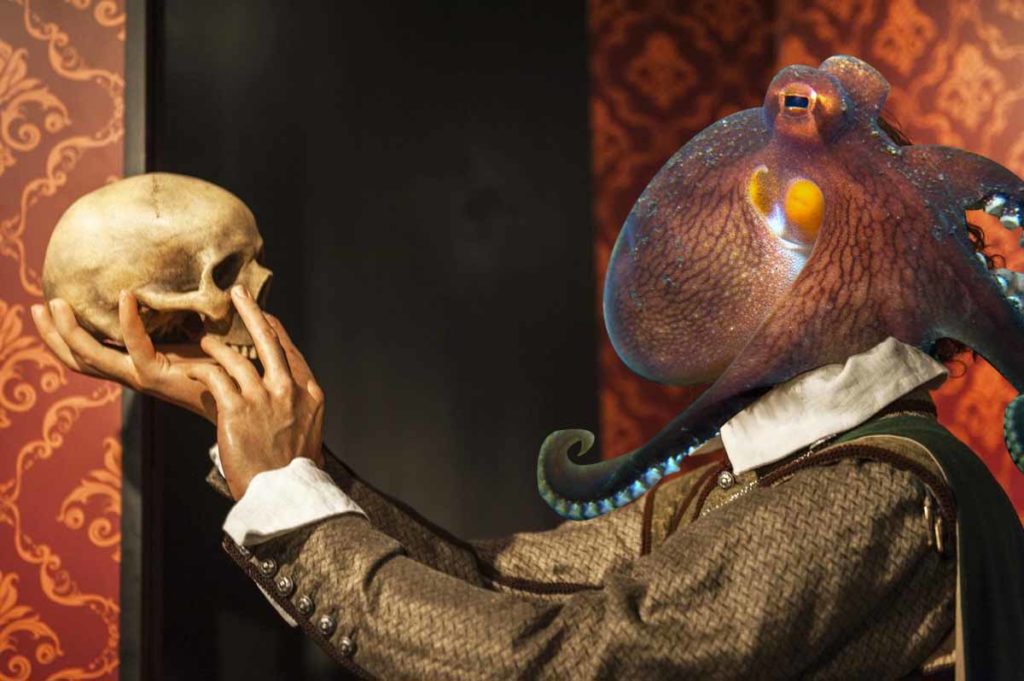
Don’t worry about these people, they correct everyone under the guise of their love for language. When really, they can’t accept that part of what makes language and writing so powerful is that it’s practically alive - changing and growing with society. If language didn’t evolve, we’d still be talking like those dorks in Shakespeare plays.
Why Octopodes is Right
If you can’t get past the Greek vs Latin issue with octopi, don’t fret. It’s fine to say octopodes. Octopus is based on the Greek oktōpous, which is a compound of “eight” (okto) & “foot” (pous). Using podes as the suffix is a more appropriate Greek pluralization.
Sure, octopi has been around long enough that it’s part of the English language. But if your interests are specific enough that you’re a stickler for the Greek roots of some English words, all the power to you. Because, hey, octopodes is also technically right.
What Do You Call A Group Of Octopuses?
You don’t. Cows have herds, ants have colonies, crows have freakin’ murders. But there is no technically correct term for a group of octopuses. That’s because all of those animals hang out in groups, whereas the octopus is a solitary animal. So it doesn’t need a collective noun.
Some people will insist on their own terms. A shoal is sometimes suggested because that’s the term for a group of squid (cephalopods & close relatives of the octopus).
Another sometimes suggested term is a clutch, but who knows why. The collective noun for chicken eggs a clutch. So maybe the connection is just that octopuses have beaks and are kind of egg-shaped.
But when the eggs hatch, a group of chicks has a new. So this won’t help you out until next Easter when you can tell people that a package of Peeps is a brood.
The term we like best is a Tangle. And we just like it because we like the image it conjures up. Because, once again, it doesn’t matter what you call a group of octopuses, because they don’t hang out in groups.
But, if they did live in groups, we like to think octopuses would arm-wrestle each other.
Octopus Are Solitary, So Don’t Worry About Plurals So Much
In fact, one of the most impressive things about the octopus is its solitary nature. They’re one of the smartest animals on the planet, and cephalopods (octopus, squid, cuttlefish) have the most complex brains of any invertebrate. But unlike all the other smartest animals, the octopus learns on its own.

Just about all of the smartest animals, like crows, dolphins, and chimpanzees, live in groups. They’re smart because they’re taught by others or are able to learn by watching their peers.
The octopus, however, doesn’t have the luxury of learning from others. They have to figure everything out on their own. So their level of intelligence and problem-solving is especially impressive. They are extremely clever animals and their level of intelligence appears to be only limited by their short lifespans.
proceeds help support Marine Protected Areas.