What’s the Point of Horseshoe Crabs Anyways?
As a general rule, once something has been around for long enough it’s going to become an essential part of its ecosystem. As well, the longer something is around the more it adapts and evolves - becoming a finely honed creature with all sorts of different species as it spreads into new environments. It’s one of the incredible wonders and beauties of nature.
And then there’s the horseshoe crab. Nature’s rusty skillet. They’ve been around for 450 million years. After surviving mass extinctions that killed off up to 96% of all marine life the horseshoe crab remains. In fact, remains relatively unchanged.
There are only 4 species of horseshoe crab, and they aren’t really that different from one another. And it’s not because of how awesome they look. They’re like a bad MS Paint version of a stingray. You probably best recognize them as the thing you skipped in the aquariums touch tank. They aren’t even crabs.
And despite their enduring existence, they’re hardly the penultimate survivor. They’re actually really fragile. If you handle them, be careful. That shell protecting their entire body, their one definable characteristic, will easily chip or break apart in your hand.
At first glance, it’s hard to see what could possibly make them remarkable. Their importance to the marine ecosystem isn’t identifiable to a casual observer. But then again…
They’ve Probably Already Saved Your Life
At the very least, they’ve stopped you from getting the mumps, polio, or anything else Jenny McCarthy doesn’t want you to get a vaccine for. It’s not just vaccines either. Since the late 1950s just about any injection you’ve gotten has probably involved horseshoe crab blood.
The FDA actually uses their blood for testing every drug. It’s the essential ingredient in LAL (Limulus amebocyte lysate) tests. The name comes from the species they harvest the blood from, the Limulus Polyphemus or Atlantic Horseshoe Crab.
How it works, is they harvest the blood from the crabs. Their blood has unique properties that make it capable of detecting contaminants in measurements as small as one part per trillion.
And horseshoe crab blood isn’t just useful, it’s blue. Not a blue tinge, full on bright periwinkle blue. The colour doesn’t do anything, it’s just because it uses a different protein than human blood. But, it’s pretty cool.
Before discovering this use for their blood scientists used rabbits. But the whole process was expensive and furry, and it didn’t produce the same quality.
More recently, scientists have come up with an effective solution, but the industry has been slow to adapt. With the price of horseshoe crab blood sitting around $15,000 per litre, there are a lot of big companies that don’t want to see the practice shut down. This is the biggest delay in making the mainstream adoption of the synthetic alternative.
A switch to the synthetic blood can make a big difference since right now we harvest about half a million horseshoe crabs each year. And that harvest has an effect on their environment.
Sea Turtles Need Them
Horseshoe crabs don’t have one of the cool spots on the food web. They aren’t at the top of the chain like sharks (nature’s greatest thing) and they aren’t where the chain begins like plankton. They’re literal bottom feeders.
They crawl around, crushing clams, worms, and algae with their legs because they evolved before jaws and teeth came standard with mouths.
Still, they actually matter. It’s pretty rare for an animal to be around for 100s of millions of years without becoming essential in their ecosystem. Just like how just about all ocean life (and by extension all life) relies heavily on sharks, another 400+ million-year-old species.
The direct impact of horseshoe crabs isn’t as high as a shark, but they’re an important food source for a lot of animals. Along every shoreline the horseshoe crab inhabits, the ecosystem would likely fail without them. As eggs, larvae, and adults, they are eaten by all sorts of shoreline marine and bird life.
Their eggs are especially important, they lay millions of them, and just about everything eats them.
Sea turtles, a far cooler shelled animal, eats them at all stages of life. Baby sea turtles eat their eggs and larvae, and by the time they’re juveniles their jaws are powerful enough to crush adult horseshoe crabs.
It’s not just turtles and local marine life either. Migratory birds plan their migration with stops to eat their eggs to refuel. Without this food source they would not survive the migration.
People Rely On Them Too
In North America, not a lot of people are eating horseshoe crabs - although they’re a delicacy in Thailand. Plain and simple, there isn’t really much meat on them. You could eat their eggs but they’re tiny. Mostly, we’re scooping them up for bait and blood.
We used to use them as fertilizer too. A practice that Native Americans started long before European colonists got there and followed suit. Once industrialization came around, horseshoe crabs were getting ground up in the millions and sold as the fertilizer terrifyingly named “cancerine.”
This practice didn’t really phase out until the 1970s when artificial fertilizers took over.
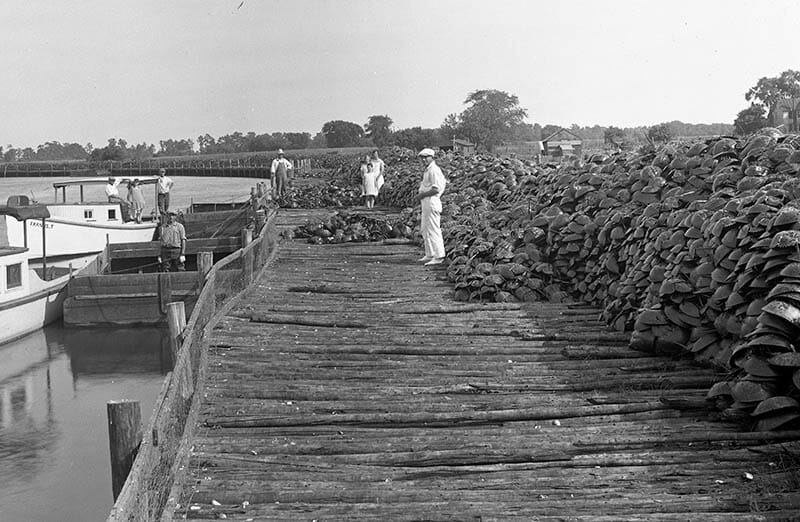
Nowadays, the big horseshoe crab harvest is more often for bait. They’re the most popular bait for eel and whelk fisherman. And apparently, a lot of people are looking to catch some eels, because the bait industry saw massive declines in horseshoe populations in the 1990s.
A decline that severely impacted their predators.
New fishing techniques, keeping the bait in mesh bags and artificial horseshoe crab bait recipes are helping to reduce the culling. But there’s a long way to go before recovery, and they’re still being caught for bait in large numbers.
The good news is, just like with fertilizer, we have artificial alternatives now for bait and blood. And they’re high-quality alternatives. The bait alternative is not only just as effective; it’s also easier for fishermen to buy, store, and process.
Impact of the Blood Harvest
The alternative to blood, Recombinant Factor C, is gaining headway and seeing some use in pharmaceutical companies. It’s effective and could be the solution to making major changes. For years, we may have underestimated the impact of harvesting horseshoe crab blood.
Although they are returned to the ocean after harvesting, estimates range from 10-30% of bled horseshoe crabs die. That could mean as high as 150,000 every year. But death isn’t the only issue.
Female horseshoes take a while to recover before they’ll mate again after this procedure. By a while, we’re looking at up to 10 years. They reach sexual maturity at 10 years and live to about 20. So harvesting females basically removes them from the breeding pool.
They’re already slow to reproduce, and with their numbers in decline, removing breeding females isn’t sustainable.
It’s worth making the push to save them.
Things are looking up. The FDA recently (November 2018) approved a drug using Recombinant Factor C for the first time.
What Can I Do?
The good news is there’s a lot you can do to help out horseshoe crabs, especially if you live nearby. You can volunteer in annual horseshoe crab counts or start a sanctuary in your community.
For people who don’t live nearby, there are plenty of options for donations, or you can write to local government supporting artificial alternatives.